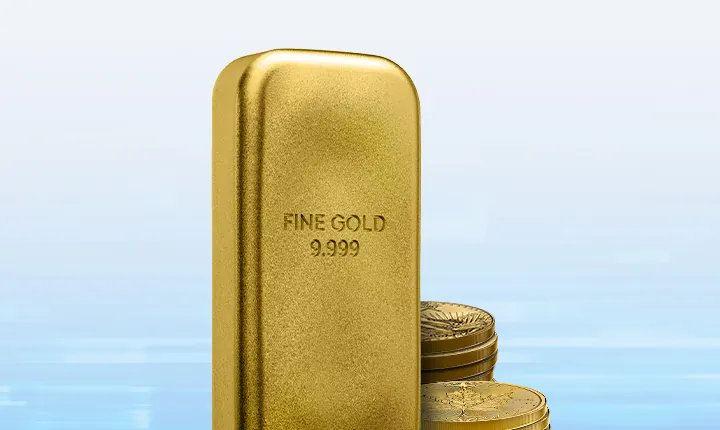
Spot Gold: What It Is and How to Invest


What "Spot Gold" Actually Means
Spot gold is the price for one troy ounce of pure gold for immediate ("on the spot") settlement. It is the reference rate quoted around the clock in the global over-the-counter market, the number that sits behind almost every headline you read about the value of gold. When commentators say gold is trading at a certain level in dollars, pounds, or euros, they are quoting the spot price. For a European investor it is worth remembering that the international benchmark is denominated in US dollars per ounce, so the figure you see in GBP, EUR, or CHF also reflects the prevailing exchange rate at that moment.
Spot differs from the futures price, which is a contracted price for delivery on a future date and typically trades at a small premium to spot to account for storage and financing costs. Spot also differs from the retail price you pay for a physical coin or bar, which adds a fabrication and dealer premium on top. Understanding spot is the foundation for understanding every other gold price you will encounter, and you can watch a live benchmark on our gold price page.
Going to the Spot Market
The spot gold market is where bullion changes hands for near-immediate delivery at the current spot price. Its centre of gravity is London, where the trade is coordinated through the London Bullion Market Association (LBMA) and physically settled via accounts held with LBMA clearing members. Participants are overwhelmingly institutional: bullion banks, refiners, mining companies, central banks, and large professional funds. Trading runs effectively 24 hours across London, New York, and Asian sessions, which is why the spot price keeps moving even when your local market is closed.
Two reference points anchor the day. The LBMA Gold Price is an auction-based benchmark set twice daily (the "London fix") and is widely used to value contracts and portfolios. Alongside it, the live OTC spot rate fluctuates continuously. For most retail investors the practical takeaway is that the spot market sets the wholesale value of gold, and every product you can actually buy is priced as spot plus a premium.
The LBMA Standards
Gold accepted in the wholesale spot market must meet the LBMA's "Good Delivery" standard. These rules exist so that institutions can trade large quantities without re-assaying every bar, and they underpin the trust that makes the market liquid. A bar that carries Good Delivery status, was produced by an approved refiner, and has remained inside the chain of accredited vaults is described as having intact "chain of custody" — a meaningful quality marker if you ever invest in vaulted metal.
- Minimum fineness of 995.0 parts per thousand (99.5% pure gold)
- Bars must weigh between approximately 350 and 430 troy ounces (a "400 oz" bar)
- Produced by an LBMA-accredited refiner on the Good Delivery List
- Held within approved LBMA vaults to preserve the chain of custody
- Fully documented provenance and serial-number tracking
- Compliant with the LBMA's Responsible Sourcing and Responsible Gold programmes
Can a Retail Investor Trade on the Spot Market Directly?
In practice, no — not in its raw institutional form. The standard unit is a Good Delivery bar of roughly 400 troy ounces, which at typical prices is worth several hundred thousand pounds or euros. On top of the capital required, you would need an account with an LBMA clearing member, the ability to settle in wholesale size, and somewhere accredited to store the metal. None of that is realistic for an everyday investor putting away a few hundred or a few thousand at a time.
This is why retail buyers historically accept a premium over spot. The premium is the dealer's margin plus the cost of fabricating, distributing, and authenticating smaller, tradeable units. The smaller the product, the larger the premium tends to be in percentage terms, which is the core trade-off explored in our guide on the best way to buy gold.
How Retail Investors Reach the Spot Price
Several routes connect ordinary investors to gold, each with a different relationship to the spot price. The right choice depends on how much you value direct ownership, low cost, liquidity, and the option to take physical delivery. The table below compares the main options as a European or UK investor would weigh them.
| Route | Relationship to spot | Typical cost | Physical delivery? |
|---|---|---|---|
| Coins & small bars | Spot + retail premium | ~4–8%+ premium on small coins; lower on larger bars | You already hold it |
| Gold ETFs (e.g. GLD, IAU, SGOL) | Tracks spot via fund holdings | ~0.17%–0.40% annual expense ratio | Generally no |
| Vaulted / digital gold | Buys at near-spot | Low premium + small storage fee | Yes, on redemption |
| Wholesale spot (LBMA) | The spot price itself | Institutional-only | ~400 oz bars |
If you want to understand the ETF route in more depth, our comparison of gold ETFs versus physical gold sets out the ownership and counterparty differences, while how to invest in gold for beginners walks through the decision from scratch.
Vaulted Gold: Spot-Linked Pricing Without 400 oz Bars
Vaulted (or "digital") gold lets individuals buy fractional ownership of professionally stored bullion at prices that sit very close to spot. Rather than buying a whole bar, you purchase a precise weight of gold held in an LBMA-grade vault, and you can buy or sell in small amounts because you are not paying to fabricate a physical coin each time. The metal is allocated and stored on your behalf, and reputable platforms publish the vault location and the right to take delivery if you choose.
This structure narrows the gap between what you pay and the wholesale spot price, while keeping the option to convert to physical bars later. With OneGold you can buy vaulted gold at spot-linked pricing, see exactly how the process works on our how it works page, and use redeem if you decide you want the physical metal in hand.
- Buy and sell fractional amounts rather than whole ounces or bars
- Pricing tracks spot, with a small premium and a modest annual storage fee
- Choose vault jurisdictions such as the UK and Switzerland, with the US and Canada also available
- Convert holdings to physical bars or coins on redemption
- Metal is allocated and segregated, not a paper claim on a pooled balance sheet
Vault Jurisdictions and Why They Matter
Where your gold is stored is not a cosmetic detail — it affects security, cost, and access. For European investors, OneGold emphasises the United Kingdom (London, the heart of the global bullion market and the LBMA) and Switzerland (long-standing neutral vaulting tradition and major refining capacity), with US and Canadian vaulting also available. Storing in a recognised LBMA vault keeps your metal within the accredited chain of custody, which preserves its Good Delivery status and makes it easy to sell back into the wholesale market at spot-linked prices.
Tax for EU and UK Investors
Investment-grade gold is exempt from VAT across the EU and the UK. Under the EU's investment gold regime (and equivalent UK rules), gold that meets the definition of investment gold — bars and wafers of accepted weights and a fineness of at least 995, and certain gold coins minted after 1800 of at least 900 fineness — is exempt from VAT. This is a genuine structural advantage of gold over its sister metals.
By contrast, silver and platinum are generally not VAT-exempt and can attract standard-rate VAT in many jurisdictions, which raises the effective cost of buying them physically. UK investors should also note that certain UK-minted bullion coins (such as Britannias and Sovereigns) carry an additional Capital Gains Tax advantage because they are legal tender. Tax treatment varies by country and by your personal circumstances, so this is general information rather than advice — confirm the position in your own jurisdiction before acting.
A Worked Example: Spot Versus What You Pay
Suppose the spot price is roughly £2,000 per troy ounce. A small one-ounce bullion coin might retail at around £2,120 once a typical premium of approximately 4–6% is included, and you may receive a little under spot when you sell it back. Buying the same ounce as vaulted gold would cost much closer to spot, plus a small annual storage fee measured in fractions of a percent. Over a long holding period, the narrower buy/sell spread on vaulted metal can matter as much as the headline premium.
The lesson is to look beyond the sticker price to the full round-trip cost: the premium you pay on the way in, any storage or management fee while you hold, and the spread you give up on the way out. For a structured comparison of providers on exactly these terms, see our review of the best online gold trading platform.
Tools That Help You Buy Near Spot
Because spot moves continuously, timing and automation can make a real difference. A limit order lets you set the price at which you want to buy or sell and have it execute automatically when spot reaches that level, rather than watching the market all day. If you already hold higher-premium products, switch and save can move you into lower-cost vaulted metal closer to spot. These are practical ways to keep your effective cost as close to the wholesale price as possible.
Risks and a Brief Disclaimer
Gold can be volatile and does not pay income. The spot price can fall as well as rise, currency movements add a second layer of risk for non-dollar investors, and physical or vaulted gold carries storage, insurance, and counterparty considerations. Gold is best understood as a long-term store of value and a portfolio diversifier rather than a guaranteed return. Nothing here is personal financial or tax advice; consider your own objectives and, where appropriate, consult a regulated adviser before investing.
Frequently asked questions
Is the spot price the same as what I pay for gold?
Why is spot gold quoted in US dollars if I invest in pounds or euros?
Do I have to pay VAT on gold in the EU or UK?
Can ordinary investors trade directly on the LBMA spot market?
What does LBMA Good Delivery mean and why should I care?
Where is vaulted gold stored?
Ready to start investing?
Open a free OneGold account and own allocated, fully insured metal in minutes.
Start Investing